
What a shopping-agent account usually holds about you
Mulebuy is the worked example here, because its interface text and site code from June 2026 survive in archived copies. Most agents collect something close to it; where a detail belongs to Mulebuy alone, the page says so.
The sign-up form and the profile page
Mulebuy’s privacy policy said that opening an account needed a name, an email address and a login credential. The profile page then asked for more, for anyone willing to fill it in. The account strings in its June 2026 interface include first name, last name, a display name, birthday, gender, country of residence, preferred language, height and weight.
Height and weight are there for sizing help, a common agent feature. They are also exactly the kind of detail people forget they ever typed. The same code supported signing in with Google, and an account opened that way carries a link to a Google identity: the link is data about you on the agent’s side, while the Google account itself sits under Google’s privacy policy.
Usually an agent keeps a profile for as long as the account exists. Mulebuy’s policy went one step further and said it would keep it permanently.
Delivery details: the part couriers and customs also see
The address form in the same interface asked for a recipient, region, state, town, street address, house number, postcode and phone number, with the courier-critical ones marked as required. A separate prompt read “Please enter your Tax ID and the corresponding name”, another asked for a VAT number, and the profile carried an “ID Card” line. Agents usually ask for identity and tax numbers only for destinations whose customs systems want them; which destinations triggered those fields at Mulebuy, the archived pages do not say.
Unlike the profile, delivery data does not stay with the agent. The name, address and phone number go onto a label and into the courier’s systems, and a description of the contents goes to customs at both ends. Those copies are held by the courier and the customs authorities under their own rules, and a letter to the agent cannot call them back.
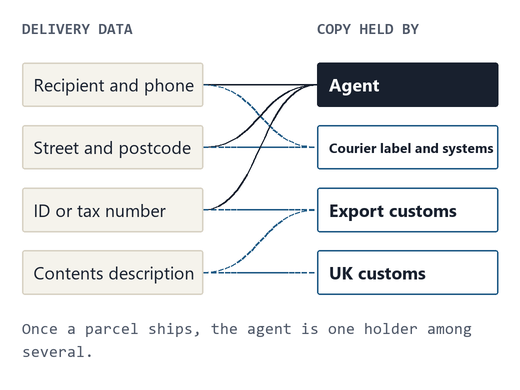
Orders, warehouse photos and the chat log
Each order adds the marketplace link you pasted, the size and colour you chose, any note for the seller, the price in yuan and every status the order passed through. In the warehouse the goods were photographed for you, and those QC photos, joined to your account, are personal data too: they show what you bought, when, and where it was heading.
Support ran through a chat widget from Intercom, which the June 2026 code loaded, and through tickets attached to each order. Chat logs tend to hold more than people expect: screenshots, order numbers, sometimes a phone number typed in a hurry. A subject access request covers them. The ICO notes that where a document also contains other people’s information, an organisation may edit that part out before sending it.
Card details, PayPal and the payment processors in between
A Mulebuy blog post of 2 June 2026 listed the ways it took money: cards from Visa, Mastercard, Maestro, Discover, UnionPay, American Express and Diners Club; wallets including PayPal, Apple Pay, Google Pay, Alipay, Skrill and MyBank; and, depending on country, Klarna, iDEAL, Blik and PayU. In the June 2026 site code, card checkout ran through a software kit from a payment company called Onerway. Its terms added that card payments handled by a Hong Kong acquirer were governed by Hong Kong law.
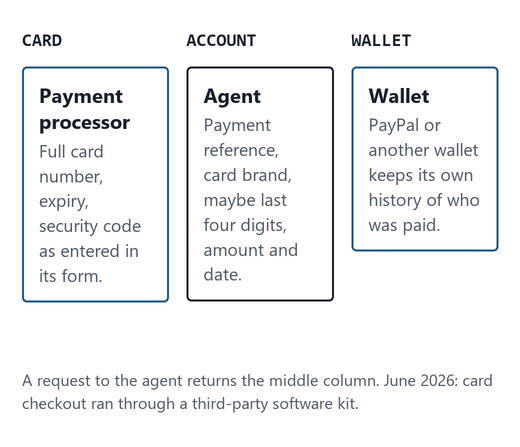
The practical point is that a full card number rarely sits with the agent. You type it into the processor’s form; the agent keeps a payment reference, the card brand, perhaps the last four digits, and the amount and date of each payment. PayPal and the other wallets keep their own record of the payment and of who was paid. A request to Mulebuy should therefore return references and amounts, while the card details stay with the processor and the wallet history with the wallet.
Identifiers you never typed
Some records were made by the site rather than by you. The June 2026 code of mulebuy.com loaded Google Tag Manager with a Google Ads tag; Microsoft Clarity, a tool that records how visitors move through a page; and the open-source FingerprintJS library. That last one builds a visitor ID from properties of your browser, stored it in the browser’s local storage and sent it along with requests to the site. The privacy policy itself only went as far as “data obtained through cookies and other computer-related information”.
Device identifiers count as personal data once they can be tied to a person, and signing in to an account is exactly that tie. The App Store label for the Mulebuy app said much the same in Apple’s format, listing “Identifiers” both under data used to track you and under data linked to you. Asking for any device or online identifiers linked to your account is a fair line in a request, and the drafter adds it when you tick app or website sign-in.
The Mulebuy app’s own privacy label
The app was listed on the App Store as “Mulebuy - Buy from China” and on Google Play under the same developer: Hong Kong Yu Xin International Trade Co., Limited, the second of the two companies named in Mulebuy’s August 2026 terms. Its last iPhone update, version 2.9.22, is dated 1 August 2026, and the Android listing showed 31 July 2026. The label in the screenshot is Apple’s format, filled in by the developer, not tested by Apple.
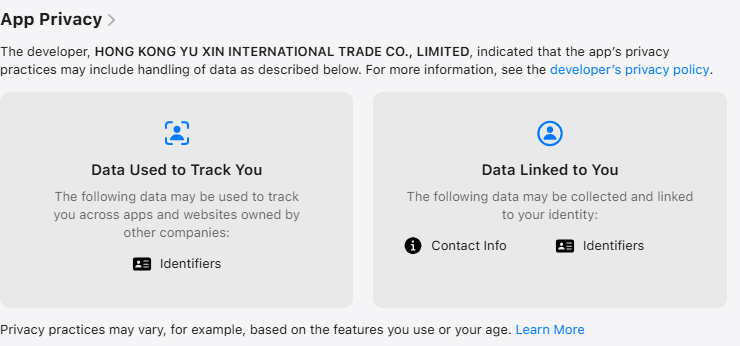
Two separate records follow from it. Whatever the app collected went to the developer, and a request to Mulebuy covers it. What Apple itself knows, such as which Apple Account downloaded the app and when, sits with Apple; Apple’s privacy policy points to its Data and Privacy page at privacy.apple.com for a copy. On Android, the Play side falls under Google’s own policy.
Three outside services, three privacy policies
Mulebuy ran a Discord server and an official Telegram group, and both were still online in mid-October 2026. Neither belongs to Mulebuy’s own records. Discord’s privacy policy, effective 29 September 2025, names Discord Netherlands BV as controller for the European Economic Area and Discord Inc. for everyone else, and says a copy of your data can be requested in the Data & Privacy section of your settings.

Telegram’s privacy policy sets out its own list of rights, from a copy of your data to deletion.
What Mulebuy may hold from those channels is narrower. Its notices in 2026 invited users to link their Discord and Mulebuy accounts for events; if you did, the link and your Discord name sit in Mulebuy’s records, and the drafter’s map puts them there. Messages you posted in the server sit with Discord.
Images: catalogue photographs are category examples, not this site’s purchases or verified Mulebuy orders. Drawn material, dimension and lettering examples explain a concept; they do not certify the depicted product.